
Flap Wheel vs Orbital Sander
This one has an honest answer: they are not competitors. An orbital sander is the right tool for flat faces, and a flap wheel is the right tool for everything that is not flat. Most woodworkers end up with both. Here is where the line actually falls.
Where the orbital wins
Flat panels, table tops, wide boards, door faces. The random-orbit pattern leaves no directional scratches, and orbital sander pads in hook-and-loop grits are cheap and everywhere. If your project is flat, use the orbital, a flap wheel on a flat face is the wrong tool.
Where the flap wheel wins
Everything with shape: routed profiles, raised panels, crown moulding, turned legs, chair spindles, eased edges, carved detail. An orbital pad bridges over coves and rounds off crisp profile edges; the flap wheel's flexible cloth strips wrap the shape and sand it evenly. It is also the distressing and finish-stripping tool, things an orbital simply cannot do.
The practical split
| Job | Tool |
|---|---|
| Table top, flat panel | Orbital |
| Raised-panel cabinet door | Orbital on the flat, flap wheel on the profile |
| Turned legs, spindles | Flap wheel |
| Crown and casing profiles | Flap wheel |
| Stripping paint from shaped parts | Flap wheel (coarse grit) |
| Between-coat scuffing on flats | Orbital, fine pad |
| Between-coat scuffing on profiles | Flap wheel, P240+ |
Grit works the same on both
Whether it is orbital pads or flap strips: coarse (60–80) strips and shapes, medium (100–150) smooths raw wood, fine (180–320) sands between coats. Our grit guide maps it project by project, the logic transfers directly to your orbital pads too.
Add the flap wheel side
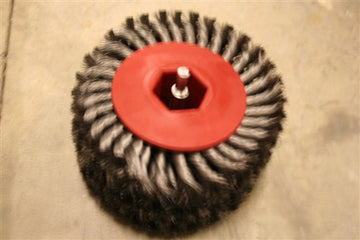 Twisted Steel Brush for Drill - 2" or 4" Wide$187.00+
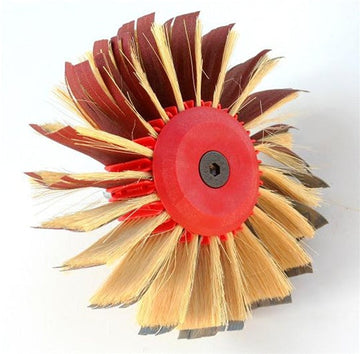 Flap Wheel for Drill - 2" & 4" Wide Brush Sanding Head$104.00+
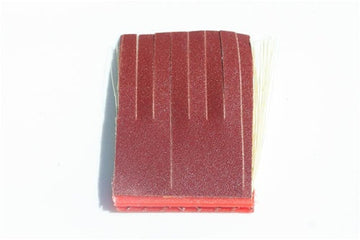 Replacement Flaps - 65mm, Flexible Trim Refill$56.00+
You already own the drill. Start with a 2" or 4" drill-attached wheel and keep the orbital for the flats, that pair covers nearly every project. New to flap wheels? Start here.